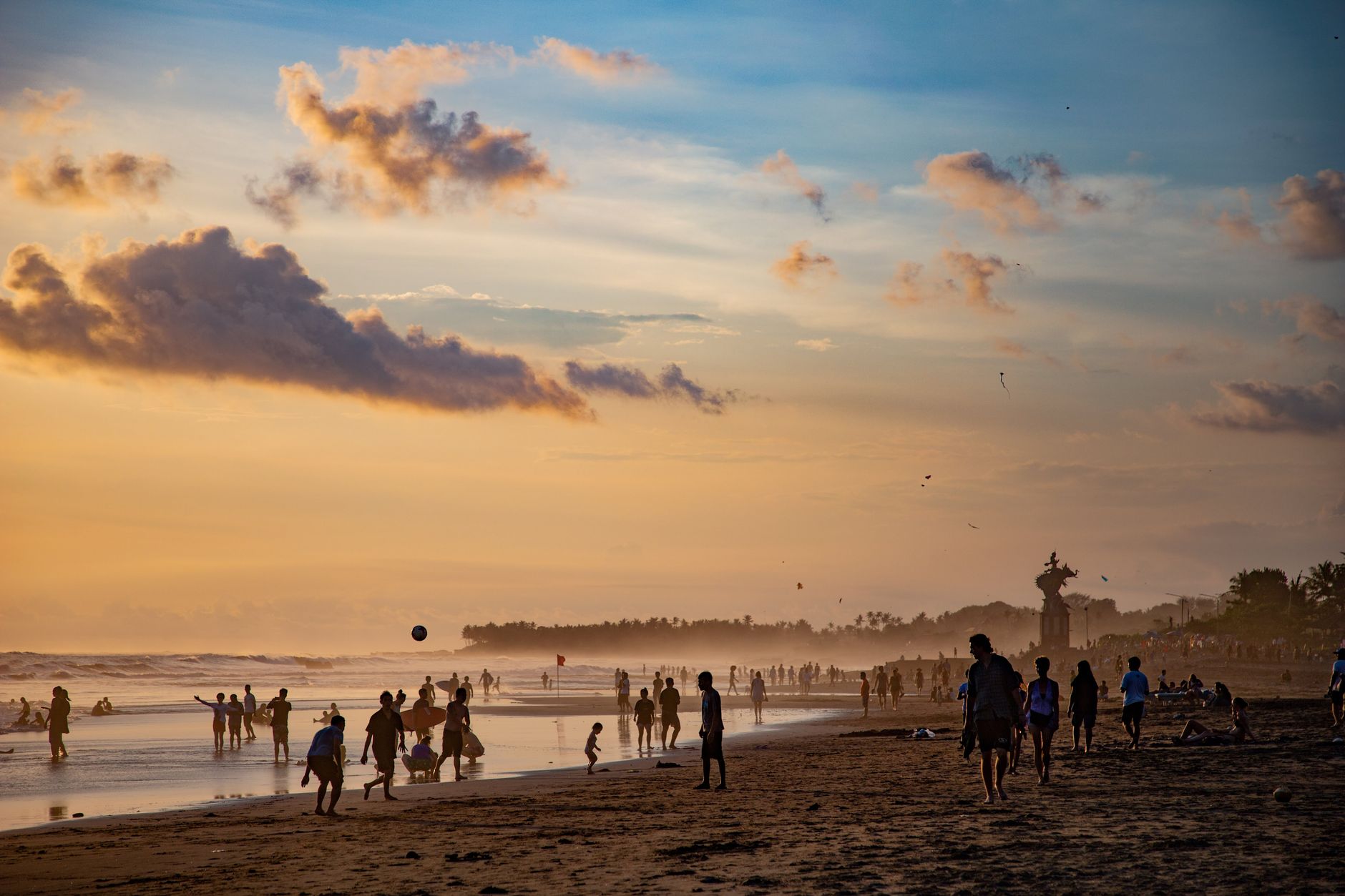
The Canggu Misconception
Canggu has a reputation problem. Most people—whether they're browsing real estate listings from abroad or arriving with a suitcase and vague Pinterest boards—treat it as a single, monolithic neighborhood. This assumption costs them clarity. The truth is more textured: Canggu is actually a federation of distinct village communities, each with its own rhythm, economics, and social texture. The neighborhood you choose determines not just where you live, but how you live.
The two poles that crystallize this division most sharply are Berawa, anchoring the polished southern edge where Seminyak's influence extends northward, and Echo Beach, the northern counterpart where the surf break of the same name shaped everything—from real estate values to morning routines to which cafés thrive.
They're separated by perhaps twenty minutes on a scooter, but the distance between their worldviews is considerably greater.
Berawa: The Curated South
Berawa reads like premium Bali's northern accent. It inherited its character from Seminyak and Petitenget—polished, design-conscious, unapologetically aspirational. This isn't a drawback; it's a fact. The neighborhood has matured into something coherent and self-aware.
The most visible anchor is Finns Beach Club, which sits at the southern terminus of Berawa Beach like an exclamation point on professional hospitality. It's Bali's most operationally sophisticated large-format beach club, meaning it functions as both genuine leisure destination and neighborhood fixture. Finns signals what Berawa is willing to invest in: quality, consistency, and polish.
That philosophy radiates outward. The restaurant and café density in Berawa skews toward considered curation rather than volume. You'll find established names, trained staff, and menus that reflect actual thought. The shopping corridor has matured similarly—boutiques, galleries, and service providers that assume affluence without performing it.
The Social Architecture
Berawa's population is genuinely mixed in a way Echo Beach isn't. Yes, there are young professionals and digital nomads here, but there are also:
- Established expatriate families with school-age children and decade-long Bali roots
- Senior professionals (both retired and semi-retired) who chose Canggu for proximity to amenities without Seminyak's congestion
- Long-term residents whose investment in property and community runs deep
- The social crowd, naturally, which moves between restaurants and beach clubs across evening hours
This demographic depth creates a different conversational texture. You'll overhear discussions about school fees, property appreciation, and renovation timelines—not just travel plans and Instagram content.
The Real Estate Thesis
Berawa property commands premium pricing, and it's not arbitrary. Villa stock tends toward the larger end (500–800 sqm living space isn't unusual), and new construction often happens here first. The materials are better. The finishes are more refined. Owners expect consistency in maintenance and security.
Land pricing reflects this established desirability: IDR 700 million to 1.5 billion per are at premium locations—roughly double the northern equivalent. But the short-term rental market is equally strong, powered by proximity to Finns Beach Club and the Seminyak corridor. Investors who understand Berawa aren't chasing novelty; they're buying into stability and operational maturity.
The Practical Infrastructure
Berawa hosts Dojo, Bali's most recognized co-working brand, with significant space and a mature professional community. The beach access is genuinely usable: Berawa Beach itself offers some of the cleaner water in the Canggu area, and while the surf isn't Echo Beach's consistent left-hander, it's reliable for intermediate surfers and perfect for those who want ocean access without surf obsession.
Trade-off: The Berawa bottleneck on main roads can choke traffic during evening hours, particularly where the road narrows moving toward Seminyak.
Echo Beach: The Authentic North
Echo Beach didn't plan to become itself. The neighborhood formed organically around a simple geographic fact: the wave that breaks at the beach's northern end is a consistent, well-formed left-hander that draws intermediate and advanced surfers with reliable predictability. Everything else—the culture, the businesses, the property values, the social rhythms—emerged from that single constant.
The result feels less manicured than Berawa and more lived-in. There's street art here that wasn't commissioned to feel authentic. There are surf shops that stock worn inventory because locals are actually buying and using it. The vintage furniture warungs and bohemian cafés aren't nostalgia installations; they're where people actually congregate between dawn surfs and afternoon work sessions.
The Social Character
Echo Beach skews distinctly younger and considerably more surf-oriented than Berawa. The demographic profile concentrates heavily around:
- Digital nomads and creative freelancers building location-independent income streams
- Dedicated surfers for whom the morning session is non-negotiable
- Young professionals in their twenties and early thirties
- Artists and musicians drawn by both the cultural scene and affordable live-work space
Family concentration is noticeably lower. This isn't judgment—it's simply that Echo Beach's infrastructure, social energy, and timing (beach access at 5 a.m. is a feature, not a bug) appeal more to unencumbered residents than to parents managing school runs and bedtimes.
The Dining and Social Scene
Here's something worth noting: the restaurant quality in northern Canggu rivals Berawa's, but it arrived through different logic. Because the resident base is composed largely of experienced travelers and creative professionals who've lived elsewhere, they have exacting standards. Good food isn't optional; it's expected. The result is a thriving restaurant scene that cares about ingredients, technique, and hospitality without performing luxury.
The social scene pulses around different rhythms than Berawa. Sunset drinks matter less than post-dawn-patrol coffee sessions. Late dinners exist, but they're secondary to early mornings. There's an authenticity to the scene that comes from shared activity (surfing) rather than shared aspirations.
Real Estate and Investment Logic
Echo Beach land prices run IDR 500 million to 1 billion per are—notably lower than Berawa's premium tier, though still elevated compared to inland Canggu. The lower entry point hasn't suppressed demand; it's attracted yield-focused investors who recognize that the short-term rental market here is sustained by a consistent flow of surfers, digital nomads, and lifestyle-seekers.
Villa stock tends toward smaller, more efficient layouts (300–500 sqm common). Newer construction is less common than renovation and adaptive reuse of older properties. The aesthetic lean toward character over newness—which appeals to a specific investor profile and repels another entirely.
The Middle Ground: Batu Bolong
Between these two poles sits Batu Bolong, a beach village that arguably captures Canggu's most authentic surf-culture flavor. It offers genuine accessibility to both northern and southern amenities without fully committing to either zone's character. It's worth considering independently if you want the cultural texture of Echo Beach with slightly more infrastructure depth.
Jalan Pantai Batu Bolong, the café and bar corridor running south toward Berawa, has become one of Canggu's most vital commercial streets—a place where both neighborhoods converge.
Comparison at a Glance
| Factor | Berawa | Echo Beach |
|---|---|---|
| Surf consistency | Good, manageable | Excellent, reliable |
| Primary beach venue | Finns Beach Club | Local format + Batu Bolong |
| Social energy | Mature, mixed | Young, activity-oriented |
| Property entry cost | Higher (premium land) | Lower (developing area) |
| Family infrastructure | Strong | Moderate |
| Co-working options | Excellent (Dojo, others) | Good (growing options) |
| Traffic/accessibility | Heavy congestion south | More direct/fewer bottlenecks |
| Rental yield potential | Stable, premium rates | Higher turnover, volume-driven |
| Authenticity quotient | Curated | Organic |
Making Your Choice
The decision ultimately hinges on honesty about your actual needs, not your imagined ones. Are you genuinely a surfer, or do you want to be? Do you have school-age children you're underplaying in your Bali fantasy? Are you seeking investment returns or lifestyle stability? Do you crave community involvement or independence?
Berawa suits: Families, established professionals, long-term investors prioritizing capital preservation and operational consistency, and anyone who values proximity to Seminyak's broader ecosystem.
Echo Beach suits: Surfers with genuinely disciplined practice, digital workers building location-independent income, younger professionals in temporary arrangements, and anyone seeking cultural authenticity and lower entry costs.
Both neighborhoods offer legitimate, different versions of what Canggu can be. The confusion arises only when you treat them as interchangeable.
Frequently Asked Questions
Which neighborhood offers better property investment returns?
Echo Beach typically delivers higher rental yield through volume—consistent demand from the surf and digital nomad markets, with lower property acquisition costs. Berawa offers capital preservation and stability, with slower appreciation but more resilient, premium-rate bookings. Your answer depends on whether you're optimizing for cash flow or long-term asset growth.
Can I easily move between Berawa and Echo Beach?
Yes, though the method matters. A beach walk takes approximately 25 minutes and offers genuine character (you'll see the shift in neighborhood texture). By scooter on main roads, expect 5–7 minutes depending on traffic. Neither direction feels distant once you understand the geography.
Is Echo Beach developing rapidly, or will it remain unchanged?
Echo Beach is developing, but more thoughtfully than some fear. New construction exists, but it's slower than in Berawa. The neighborhood's character is durable enough that rapid commercialization would destroy its primary draw (authenticity), so market forces may self-regulate. That said, five-year predictions are always uncertain in Bali.
Which neighborhood has better infrastructure—gyms, doctors, schools?
Berawa's infrastructure is more established and comprehensive. Echo Beach has adequate options for adult residents (gyms, clinics, restaurants) but limited school options, which matters significantly for families.
If I'm interested in surfing but not a full-time surfer, where should I live?
Batu Bolong or southern Echo Beach. You'll have genuine beach access and competent local instruction without fully committing to a surfer identity. Berawa works only if you're genuinely comfortable not surfing most of the time.