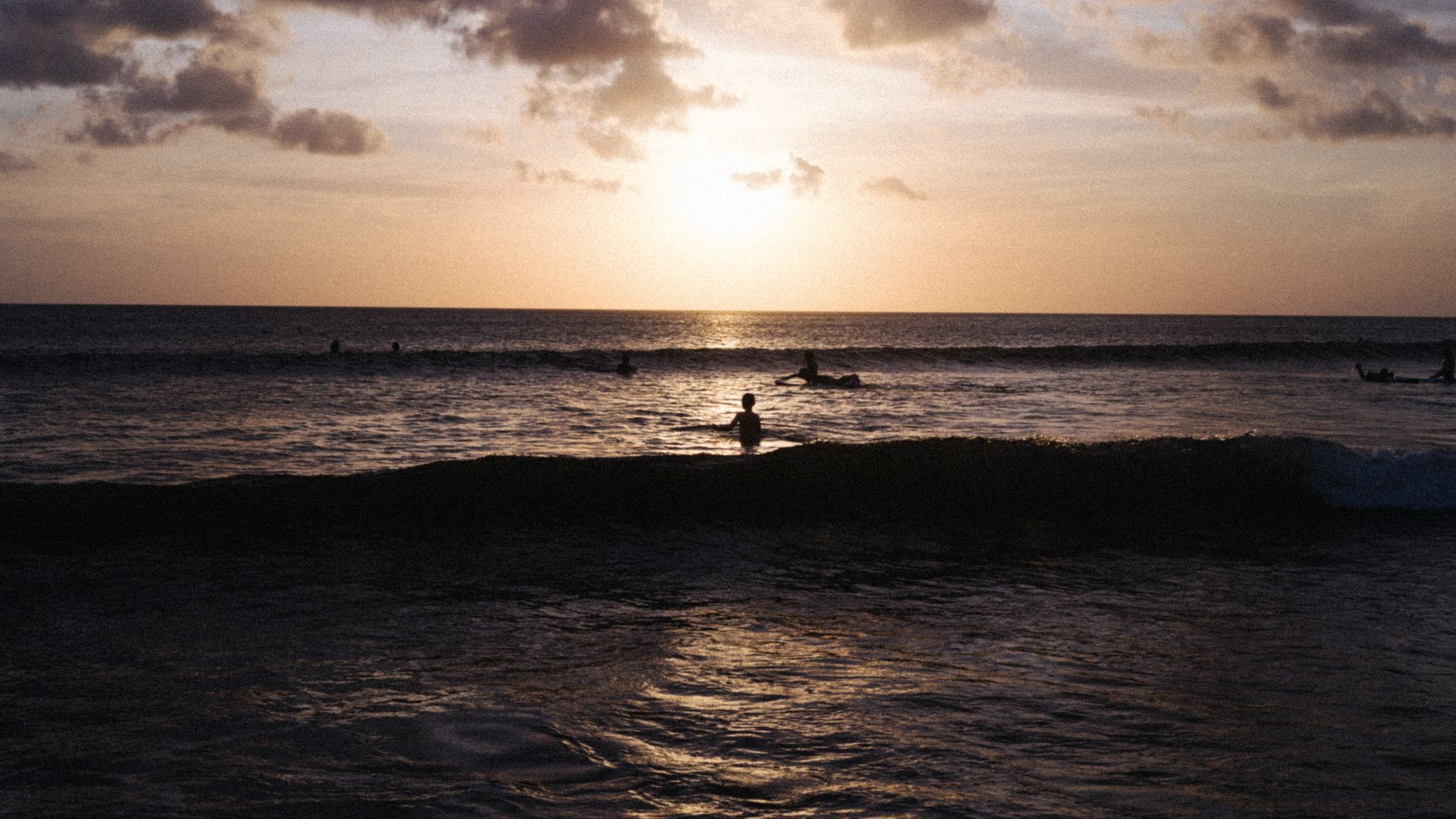
The Perfect Convergence
There's a reason Bali has become the unofficial surfing university of the world. It's not mythology or marketing—it's physics, geography, and a fortunate alignment of conditions that simply don't exist everywhere. For anyone contemplating whether they could actually learn to surf, Bali doesn't just say yes. It removes every practical obstacle standing between intention and execution.
Warm water that requires no wetsuit. Waves that are forgiving without being boring. Instructors who've refined their craft across thousands of students. Prices that make committing to multiple lessons feel financially sensible rather than indulgent. On paper, it reads like someone designed the island specifically to answer the question: How do we make surfing accessible?
The answer, it turns out, is Bali.
Where the Learning Actually Happens
The South Coast Classics
Kuta Beach remains the foundation of Bali's beginner surfing ecosystem for good reason. The waves roll in with predictable consistency, their whitewater arriving at angles that feel almost pedagogical. Yes, it's crowded—but that length of sand has a way of distributing hundreds of students across its expanse without feeling chaotic. Nearly every surf school operating in South Bali rotates beginners through Kuta at some point, a testament to its reliability.
Legian Beach, sitting just north of Kuta's bustle, offers the same wave quality with fewer elbows. During peak lesson hours, it often becomes the smarter choice for a first session—same conditions, better real estate.
For those seeking even gentler waters, Seminyak's northern end provides softer wave energy ideal for absolute beginners. Fewer dedicated schools operate here, which paradoxically becomes an advantage: more breathing room, less crowding, a quieter introduction to the sport.
The Eastern Alternative
Sanur deserves particular mention for those prioritizing comfort over cool factor. The reef-protected lagoon creates conditions so manageable they almost feel designed for learning. The vibe skews practical rather than culturally surf-saturated, but that's precisely the point—the focus stays on technique rather than atmosphere.
The Canggu Adjustment
For those staying further north, Seseh and Cemagi (the beaches just beyond Canggu proper) offer something Echo Beach doesn't: consistency without excessive power. The waves here maintain that sweet spot—enough energy to feel real, gentle enough to remain forgiving.
Inside the Lesson
A standard beginner session unfolds in two distinct phases across roughly 90 minutes to 2 hours.
First comes land instruction—typically 20 to 30 minutes of dry-land fundamentals. Your instructor walks you through the pop-up sequence (that moment of controlled explosion from lying to standing), correct paddling mechanics, water safety protocols, and how to read a wave's intentions. This isn't wasted time. Muscle memory begins here, before you ever enter the ocean.
Then you're in the water, usually with 2 to 4 fellow students and your instructor working closely within arm's reach. The actual practice is delightfully simple: your instructor positions you on the board, reads the approaching whitewater, and pushes you into the wave at precisely the right moment. Your job is to pop up. Repeat. Adjust. The learning happens in these compressed moments of actual application.
Most beginners stand up during their first lesson. Some nail it immediately; others take longer. Both experiences are entirely normal.
Evaluating Schools and Instructors
Not all surf schools operate at the same standard. The difference between a quality program and a mediocre one isn't subtle—it directly impacts your experience and progression.
Look for these markers of legitimacy:
- International Surfing Association (ISA) certified instructors — This credential matters more than brand reputation
- Soft-top boards designed for learning — Not fiberglass shortboards that punish mistakes
- Provided rash guards — Sun damage accumulates faster than most people realize
- Insurance coverage — Professional programs carry it; amateurs don't
- Reasonable instructor-to-student ratios — One teacher to two students maximum in the water, never more
Warning signs worth heeding:
- Schools promoting hard fiberglass boards for beginners (they're unforgiving and dangerous)
- Suspiciously low prices suggesting enormous group sizes
- Instructors who disappear or multitask while students practice
By location:
Kuta hosts numerous established operations—the oldest have systematized their approach to the point where beginners receive consistent, professional instruction regardless of which school they choose.
Canggu's Bali Learn to Surf and Rapture Surfcamp maintain strong reputations for thoughtful programming that respects student progression.
Those based in Ubud can arrange beach transfers through various operators, though the journey eats into lesson time.
The Financial Reality
Surfing lessons in Bali occupy an unusual sweet spot: accessible without feeling cheap.
A group lesson spanning two hours typically costs between IDR 250,000 and 500,000 per person—roughly equivalent to a nice dinner. Private instruction commands IDR 500,000 to 800,000 for 90 minutes. If you're considering genuine skill development, multi-lesson packages (5 to 10 sessions) deliver better value, ranging from IDR 1.5 to 4 million—still modest for comprehensive instruction.
Once you've progressed beyond formal lessons and want to rent a board independently, soft-tops run IDR 50,000 to 150,000 per hour. By that point, you'll know whether surfing has captured you or served its purpose as a spectacular Bali experience.
The Timeline to Competence
Progression isn't linear, but patterns emerge.
After your first lesson, most students successfully catch and ride whitewater waves—not by accident, but because your instructor positioned you perfectly. That initial success matters psychologically.
By five lessons in (assuming consistent practice), you'll reliably catch green waves and ride them toward shore with something approaching control. You won't be graceful. You won't be efficient. But you'll be surfing.
Reach 20+ cumulative hours of instruction and practice, and you'll begin recognizing how to position yourself in the lineup, reading wave quality and your own capability with increasing accuracy.
The important variable isn't how fast you progress—people learn at genuinely different rates. What matters is that Bali's conditions, warm water, and accessible instruction mean the learning process itself remains pleasurable throughout. You're not white-knuckling through cold water or struggling with heavy equipment. You're moving through warm ocean with someone who's taught thousands before you.
Making the Decision
Surfing occupies a strange space in travel—it's accessible enough that anyone can try it, complex enough that committing to real learning is genuinely rewarding. Bali has engineered an environment where that commitment feels natural rather than daunting.
You don't need prior experience. You don't need expensive gear. You don't need to be an elite athlete. What you need is basic swimming ability, a willingness to look silly in front of an instructor, and a few days to let the practice sink in.
Bali handles the rest.
FAQ
Do I need to be a strong swimmer?
Basic swimming ability is necessary—you should be comfortable swimming approximately 50 meters and floating without support. You don't need to be competitive-level athletic, but water comfort is non-negotiable for safety.
What should I actually bring to a lesson?
Sunscreen (apply liberally before entering the water; bring waterproof varieties for reapplication), a change of dry clothes, and a water bottle. Your school provides boards, rash guards, and instruction. Everything functional is covered.
Is Bali's ocean actually safe for beginners?
Bali's coastal waters maintain warm temperatures year-round (26–29°C) and generally clear visibility. The south coast does experience strong currents—but this is precisely why staying with an instructor matters. They know how to position you safely and how to read conditions that might challenge solo swimmers.
Can I expect to surf independently after a few lessons?
You'll catch waves during your first lesson, but independent wave selection and positioning develops over weeks of practice. Think of initial lessons as guided exploration—you'll understand what surfing feels like, but genuine autonomy requires more time in the water.
What's the best time of year to learn?
Bali's consistency means year-round learning is viable. Dry season (April–October) offers more predictable conditions; wet season occasionally brings larger swells that can overwhelm beginners. Neither is prohibitive—your instructor will choose appropriate breaks regardless of season.